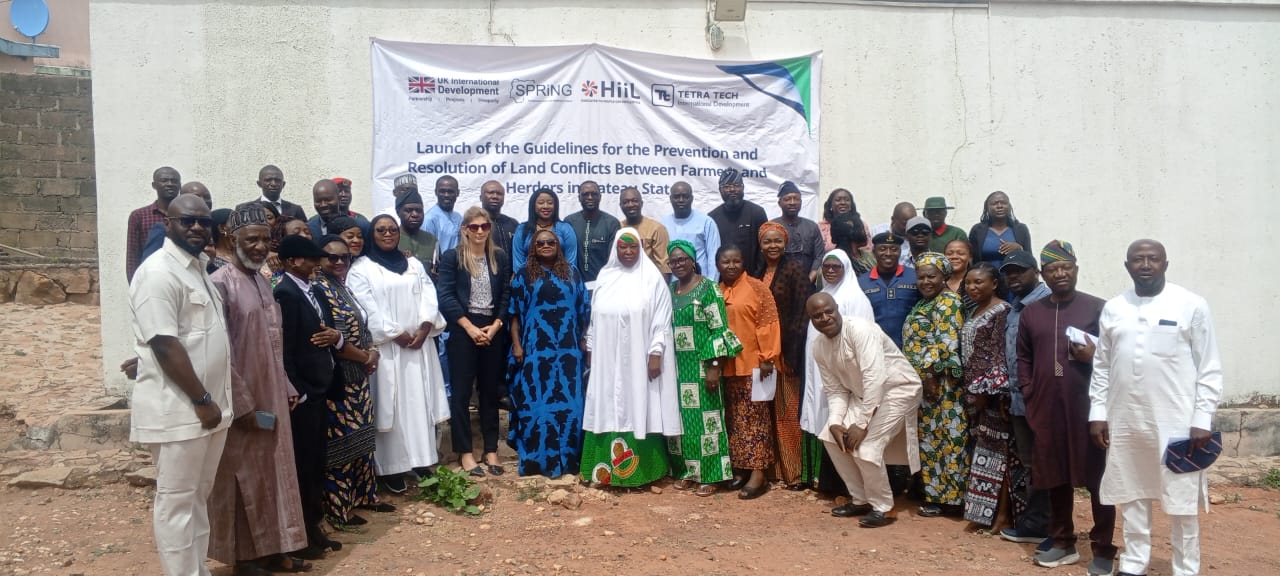
In an effort to tackle the spate of violence in Plateau State, which is mostly linked to the farmers-headers related conflicts, stakeholders have met to find a peace roadmap and resolutions aimed at halting hostilities.
The meeting which took place in Jos the state capital yesterday was at the public presentation of guidelines for the prevention and resolution of land conflicts between farmers and headers, upon which representatives of the 600 persons who were also trained in communities on peaceful resolution of the conflicts also shared their experiences.
As a result, it had representative of the parties (farmers and headers), including security agents, traditional and religious leaders, the Plateau State government, among others.
Speaking at the presentation, the Country Representative of the Hague Institute for Innovation of Law (HiiL), Ijeoma Nwafor, explained that the document containing the guidelines followed a thorough practical evidence-based research among the farmers and the headers in Plateau State.
Nwafor pointed out that the parties were identified through consultations with 73 experience communities and justice actors via focus group discussions.
According to her, the discussions also had 12 participants from both formal and informal sectors, providing a strong locally grounded foundation for the guidance that follows.
She revealed that when they went into the field for the research, they found out that some criminality has already crept into the farmers-headers conflict, and it is already intensifying the conflict.
As part of this work, she said, HiiL is implementing activities under the Strengthening Peace and Resilience in Nigeria (SPRING) Programme, funded by the UK Foreign, Commonwealth and Development Office (FCDO), and that he programme focuses on supporting communities and institutions to prevent conflict, strengthen resilience, and promote peaceful coexistence in areas affected by farmer-herder disputes.
“The guidelines is a compilation of both the desk research and the field research. The desk research is to find out how or what people have been doing on such conflicts and how to resolve them across level.
“While at the field research, we did key individual interviews from real stakeholders who have been affected by the conflict, so that we can garner first hand information from them.
“These stakeholders included the farmers and headers themselves, the women, youths, persons with disabilities, as well as the traditional and religious leaders and community leaders. Others are the law enforcement agencies, the academia, etc.
“And they all bore their minds on how the conflict can be resolved, and today is the presentation of that document. And we are also looking forward to distributing the information gathered through oral, pidgin and written local languages because grammar is never a solution to local conflict,” she stated.
Reacting, the Chairman of the All Farmers Association of Nigeria (AFAN) Plateau State chapter, John Wuyep, said the guidelines for resolution of the conflict is a welcome development.
According to him, if not for the criminality that has crept into the conflict, the farmers and the herders have always resolved their disputes peacefully, adding that sometimes there is no clear demarcation between the farmers and the headers, as many herders even farm more than the tagged farmers, while many farmers too rear cattle.
He then called for the political will to facilitate the execution of the guidelines in order to boost the understanding between the farmers and the herders, as well as to address the conflict
On his part, the former Chairman of Miyetti Allah Cattle Breeders Association of Nigeria (MACBAN) Plateau state chapter, who is now the National Public Relations Officer (PRO) of the association, Alhaji Muhammad Nuru, said the effort is commendable.
According to him, the guidelines which is the working document by HiiL and presented to the state through the stakeholders are workable and achievable, having gone through it.
He appreciated the HiiL research efforts in collaboration with SPRING, saying that it has brought out modalities and an easier way to resolve conflicts among the farmers and the headers.
Nuru urged the communities in the state to read document first, enumerate the guidelines, exhaust them and scrutinize them.
After that, he said, the message can then be passed across to the grassroots so that they can understand the value of peace and also adhere to the peace processes.
A key highlight in the guidelines is to identify and facilitate grazing routes and corridors, farming plots, establishment of community-based early warning and early response systems and facilitation of joint resource-use agreement on land, water and pasture.