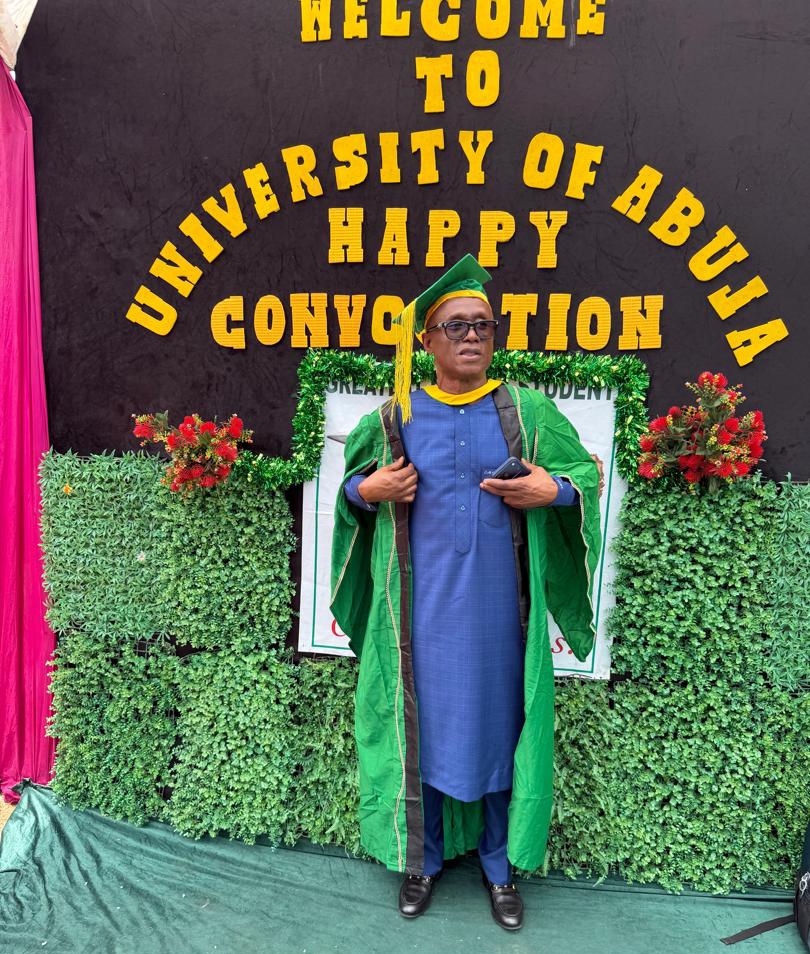
The Kaduna State Commissioner for Local Government and Chieftaincy Affairs, Hon. Sadiq Mamman Lagos, has added another significant milestone to his career profile after earning a Master’s Degree in Public Administration (MPA) at the University of Abuja’s combined 29th and 30th convocation ceremony.
The event, which drew dignitaries, academics, public officials, and proud families from across the country, marked not only a celebration of academic achievement but also a reaffirmation of the value of continuous learning in leadership and governance.
Among the graduating class, Hon. Mamman Lagos stood out as a serving public official who has chosen to deepen his intellectual capacity while actively discharging the responsibilities of public office.
His attainment of the MPA is widely seen as a reflection of his dedication to personal development and a deliberate effort to strengthen his effectiveness in public service.
In an era where governance increasingly demands technical knowledge, policy expertise, and administrative competence, his academic pursuit sends a strong message about the importance of equipping leaders with the right tools to deliver meaningful impact.
As Commissioner overseeing local government administration and chieftaincy affairs in Kaduna State, Hon. Mamman Lagos has been at the forefront of coordinating grassroots governance, mediating traditional institution matters, and supporting policies aimed at improving service delivery at the community level.
His successful completion of the programme underscores discipline, resilience, and a clear vision for self-improvement.
The Master’s Degree in Public Administration is designed to provide advanced knowledge in governance, policy formulation, public sector management, and institutional leadership.
By acquiring this qualification, Hon. Mamman Lagos is expected to further enhance his capacity to navigate complex administrative challenges, implement people-oriented policies, and strengthen institutional frameworks within the state.
Colleagues and associates have described the achievement as both inspiring and strategic. They argue that at a time when Nigerians are increasingly demanding accountability, transparency, and efficiency from public office holders, leaders who invest in education are better positioned to respond to these expectations.
Hon. Lagos’s accomplishment, therefore, goes beyond personal success; it represents a broader commitment to raising the standard of governance.
The convocation ceremony itself was a moment of pride for many families and institutions, as graduates from various disciplines were conferred with degrees in recognition of years of hard work and perseverance.
His academic journey is also expected to inspire younger public servants and aspiring leaders, particularly in Kaduna State, to prioritize education and continuous learning. In a system where experience is often valued, the integration of academic excellence provides a more holistic approach to leadership one that combines theory with practice for better outcomes.
Furthermore, stakeholders believe that such achievements contribute to building public trust. When citizens see leaders actively improving themselves, it fosters confidence in their ability to make informed decisions and manage public resources effectively.
As Kaduna State continues to pursue reforms in local governance and strengthen collaboration with traditional institutions, the enhanced expertise of key officials like Hon. Mamman Lagos is expected to play a critical role.
His newly acquired knowledge in public administration could translate into improved policy implementation, better coordination at the grassroots level, and more responsive governance.
In all, the Commissioner’s academic success is a testament to the enduring value of education as a catalyst for growth and development. It highlights the need for leaders to remain students of knowledge, even while in positions of authority.
With this new academic feather added to his cap, Hon. Sadiq Mamman Lagos not only celebrates a personal victory but also reinforces a larger narrative that effective leadership is rooted in continuous learning, discipline, and a genuine commitment to serving the public good.