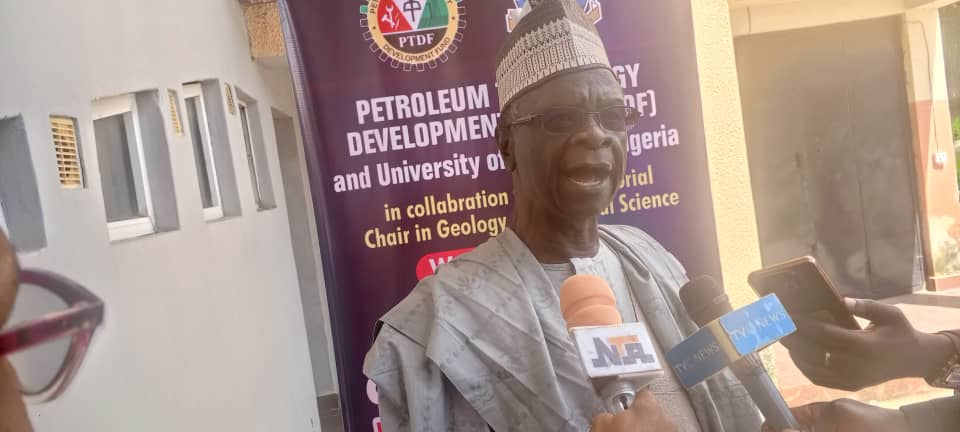
In an effort to advance best practices in the mining industry, revolutionize the primitive method and to curb the insecurity linked to the sector, the Petroleum Technology Development Fund (PTDF) and the University of Jos in collaboration with the Professional Chair in Geology and Mineral Science have trained no fewer than 250 miners in Plateau State.
The two-day capacity building workshop/training which is also aimed at strengthening the technical knowledge and operational skills of miners also included safety practices and sustainable resource development.
Again, the training was aimed at improving the livelihoods of miners, support the government’s efforts to raise revenue, and ensure sustainable national development.
Speaking on the training, the Executive Secretary of PTDF, Ahmed Galadima Aminu, explained that it was part of the Fund’s efforts to expand human capacity development beyond petroleum into Nigeria’s growing solid minerals.
He explained that the workshop with the theme, ‘Enhancing Safety, Sustainability, and Community Development in Mining’ was an important move in aligning artisanal miners with global best standards, and called on stakeholders in the mining sector to embrace modern mining practices in a bid to curb insecurity in the country and develop the sector.
Represented by the Deputy General Manager, Projects, Paul Ohabuike, the Executive Secretary stressed that adherence to international standards and best practices can strategically reduce insecurity issues in mining communities.
According to him, PTDF’s commitment to promoting safety and sustainability in the mining cannot be overemphasized, noring that the programme is part of the agency’s research and innovation mandate.
“While security is a broader issue, PTDF’s role is to ensure miners are trained on best practices and safety standards. Once the standards and best practices are followed, many of the insecurity issues will be reduced.
“At the end of this training, we expect miners to adopt safety practices, adhere to standards, improve environmental management, and enhance the ecosystem and livelihoods where mining takes place,” he said.
In his remarks, the Vice Chancellor of UNIJOS Prof. Tanko Ishaya, who was represented by Prof. Samuel Odey, said the programme demonstrated academia’s role in addressing national challenges through collaboration.
The Vice Chancellor pointed out that the programme reflects the power of collaboration among academia, industry, government, and grassroots communities, including community development.
He added that the University of Jos is honoured to host the workshop because the initiative strongly aligns with the institution’s commitment to knowledge-driven solutions that will improve lives and protect the environment.
According to him, the Middle Belt region is rich not only in mineral resources but also in human potential, and called for education and research to drive inclusive development and safer mining practices.
On his part, the Chairman of UNIJOS PTDF Professorial Chair in Geology and Mineral Science, Prof. Nuhu Samaila, described the workshop as will uniquely address environmental concerns, as the training was designed to foster dialogue between miners, scientists, and policymakers, with a focus on health and safety, responsible mining processes and waste management.
In his remarks, Chairman of Miners Association of Nigeria, Plateau State Chapter, represented by Johnson Nwosu, explained that among the miners’ challenges are harassment, multiple taxes, revoked licenses, and high interest rates.
Therefore, he called for single-window licensing, transparent revenue audits, micro-licensing for artisanal miners, and a dedicated mining security task force.
The Plateau state Commissioner for Environment, Climate Change, and Minerals, Peter Gwom, in his address pointed out that among the challenges are policy gaps in the sector and regulatory inconsistencies.
He then stressed the need to enforce existing regulations rather than create new ones, adding that the state government recently approved the continuation of over 40 abandoned mining projects across local government areas to curb illegal mining and support economic recovery.