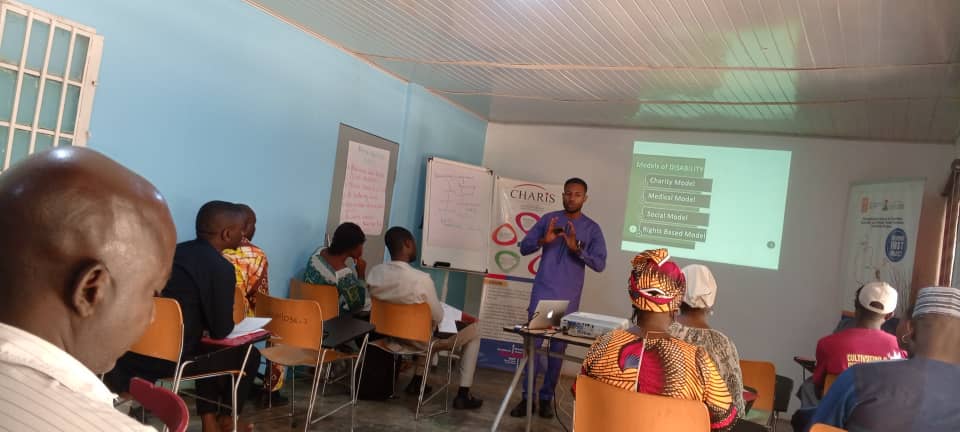
Charis Healthcare and Community Support Initiative has inaugurated a committee that will advance the rights and privileges of Persons Living With Disabilities (PLWD) and the taskforce was charged with the mandate that is expected to have community impacts.
The inauguration which was done in Jos the Plateau State capital was tagged ‘Activating Disability Rights at the Grassroots: Launch of Taskforce for Disability Policy Implementation’.
The committee is made up of the Plateau State Disability Rights Commission, members of the Joint Association of Persons with Disability (JONAPWD), Equal Basis Development Initiative, International Center for Peace and Charities and Human Development (INTERCEP). Others are the Matrix Chambers, League for Human Rights and the Centre for the Advocacy of Justice and Rights (CAJR) and members from CHARIS Healthcare and Community Support Initiative.
And the mandate of the committee are: to review the state disability law, ensure enforcement of the disability law at local government level, to oversee data collection for planning at local government level, and oversight of disability compliance.
While the committee is chaired by Mr Yenle Joshua K. (JONAPWD) and the
Secretary is Anastasia Okwuorah (INTERCEP), and it has representative of Persons with Disability- Izang Bala Bulu (Plateau State Disability Rights Commission), representative of CSOs- Aisha Ganger (CHARIS Healthcare and Community Support Initiative) Lagal Advicer- Kefas Grace Wanma (Matric Chamber)
Excited by the inauguration of this committee, the Persons Living With Disabilities (PLWD) in Plateau State have said this would address their discrimination, stigmatization and other forms of ill-treatment towards them in the society.
In her remarks, one of the persons with disability, Rhoda Dashi, said the importance of the committee is that it will ensure that the rights of persons with disabilities are implemented down to the grassroots/rural areas where the persons don’t often know their rights.
Mrs Dashi who is visually impaired said she has been discriminated against many times in the community where she lives, citing examples of election period where they find it difficult to exercise their franchise or the hospital where health workers treat them with disdain, among other places.
“Even in the hospital, whenever I go for treatment, antenatal or to give birth, I am always discriminated against. Sometimes the nurses will be speaking to me harshly and be questioning me that why did I get pregnant as a blind woman or who asked me to get married as a blind woman? They won’t even want to give me the bed to lay on in the hospital,” she said.
She said she is now 48 years old and has been visually impaired since she eight years old, adding that her husband is also virtually impaired and they have three children who have their sight/not virtually impaired.
Another person with disability, Joshua Yenle said following the numerous discrimination they are experiencing day-in-day-out, pushing for the implementation of the law will address their many challenges, and that gone are the days when they are oblivious of their rights in the society.
In his presentation, the Programme Manager of Charis, Henry Ojenya, said there is lack of loca government level disability frameworks due to gaps in local implementation and limited disability disaggregated data.
The Programme Manager noted that as s a result of this, disability inclusion at the Local Government level is almost nonexistent, thereby leaving about 95% of PWDs in rural communities without access to essential services like health, education, rehabilitation, economic support, etc.
The policy Framework therefore, he said, will fill this gap by offering LGAs a comprehensive. blueprint for disability-inclusive governance.